










Quick answer: Neither is better for everyone. An indoor sauna suits you if you have a spare room, garage corner or big bathroom and want the shortest walk to the heat. An outdoor sauna suits you if you have a flat bit of garden and want a separate retreat. Space, power, moisture and how you like to cool down decide it.
What is the main difference between an indoor and an outdoor sauna?
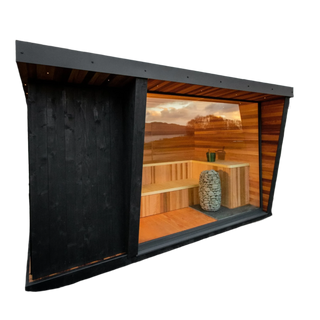
An indoor sauna is a timber room that sits inside your house. An outdoor sauna is its own small building, like a cabin or a barrel, that sits in your garden.
Both get hot the same way. A heater warms a pile of stones, the stones warm the air, and you pour water on them for steam. The big differences are about where it lives, how it is built, and what it needs around it.
- Indoor: lives inside your walls, so the house protects it from the weather.
- Outdoor: has its own roof and walls, so it is built to handle sun, wind and rain.
How much space do you need for each?
Saunas can be smaller than people think. Harvia, the Finnish heater maker, says a 2-person sauna can start from around 1.5 m² of floor space.
For an indoor sauna, Harvia suggests a dry, well-ventilated room with a solid floor. It also suggests leaving at least 30 cm between the sauna roof and the ceiling, and 5 cm of clearance around the walls. Common spots are a bathroom, a home gym or a spare room. Corner models help when floor space is tight.
For an outdoor sauna, you need a level, stable base. Harvia lists options like a terrace, concrete pavers or compacted gravel. It says heavy foundations are not needed, but you do need to allow for drainage and airflow underneath.
Tip: measure twice. Check your doorways, hallways and garden gate too, because the sauna has to get in before it can go up.
What are the pros and cons of an indoor sauna?
Indoor saunas are great for everyday use. Here is the honest picture.
- Pro: close by. On a cold Canterbury night, you do not have to walk outside to get to it.
- Pro: sheltered. No rain, frost or UV on the outer timber.
- Pro: next to a shower. If it sits near a bathroom, cooling off is easy.
- Con: uses up a room. That space is now a sauna space.
- Con: moisture planning. Steam has to be managed so it does not end up in your house.
HUUM, the Estonian heater maker, explains that a sauna room needs a continuous vapour-tight layer, with every joint taped, and an air gap of at least 20 mm between the vapour barrier and the timber lining. A well-made indoor sauna kit takes care of this inside the cabin. The room around it still needs good airflow.
What are the pros and cons of an outdoor sauna?
Outdoor saunas feel like a little escape. Many people love that walk across the garden.
- Pro: keeps your house free. No room is lost inside.
- Pro: a real retreat. Bird song, fresh air and the night sky between rounds.
- Pro: more choice of heat. Some outdoor models can take a wood-burning stove as well as an electric heater.
- Con: weather. The outside timber needs oiling or staining from time to time.
- Con: groundwork. You need a level, well-drained pad and a power supply run out to it.
Outdoor saunas come in different shapes. Cabin saunas look like a small garden room and often have a porch. Barrel saunas are round and compact. Both work well. It mostly comes down to looks, space and how many people you want to fit.
Does an indoor or outdoor sauna need different power or ventilation?
Power: both need the right supply for the heater you choose. Bigger heaters can need more power, and some homes have single-phase power while others have three-phase. A registered electrician must do all hard-wiring. We give every sauna customer our Electrician's Cheat Sheet so your sparky has what they need. For outdoor saunas, the power also has to reach the garden, so ask your electrician about that early.
Ventilation: every sauna needs fresh air in and stale air out. Harvia says the air in the sauna should change six times per hour. With an electric heater and natural airflow, Harvia places the fresh-air vent below or next to the heater, and the exhaust near the floor, as far from the heater as possible. HUUM lists poor ventilation as one of the three most common sauna-building mistakes.
Indoor saunas also need the room around them to breathe. Outdoor saunas have vents built into their own walls.
Which one is right for your home?
Ask yourself these simple questions.
- Do I have a spare room or corner? If yes, indoor is worth a look.
- Do I have a flat, sunny patch of garden? If yes, outdoor could be perfect.
- How do I want to cool down? A shower inside, or an ice bath or garden hose outside?
- How many people will use it? Outdoor saunas often fit bigger groups.
- Do I want a wood fire? That points to an outdoor sauna.
Whichever way you go, get the heater size right. HUUM says the most common mistake is choosing a heater that is too small, and uses a simple rule of thumb of about 1 kW of heater power per 1 m³ of sauna. Glass and tiled walls soak up heat, so they push that number up. Curious how long it takes to warm up? Read How Long Does a Sauna Take to Heat Up?
A quick safety note: sauna heat is intense. If you have a health condition, are pregnant or take medication, please check with your GP before you start.
Key takeaways
- Indoor saunas are close and sheltered, but need a spare space and good moisture control.
- Outdoor saunas keep your house free and feel like a retreat, but need a level, drained base and some timber care.
- Both need the right power, set up by a registered electrician, and good ventilation.
- Pick the heater by room size: roughly 1 kW per m³, more with glass or tile.
- Measure your space, access path and power before you choose.
Frequently asked questions
Can I put a sauna in my bathroom?
Yes, a bathroom can work well for an indoor sauna. The room needs good ventilation, and any waterproofing in wet areas must be fully watertight.
Do outdoor saunas need a concrete slab?
Not always. Harvia says a level, stable base like pavers, a terrace or compacted gravel can work, as long as it drains well and lets air flow underneath.
Is an indoor or outdoor sauna cheaper to run?
Running cost depends mostly on the heater size and how often you use it, not on where the sauna sits. A smaller, well-sealed sauna with the right-size heater uses less power.
Can I use a wood-burning stove in an indoor sauna?
Wood-burning stoves are far more common in outdoor saunas. The stove and chimney must always be installed following Harvia's manual and the safety distances in the specifications.
How much space does a 2-person sauna need?
Harvia says a 2-person sauna can start from around 1.5 m² of floor space. Allow a little extra room around it for airflow and access.
Ready to explore? Browse our indoor saunas and outdoor saunas, including cabin and barrel styles. We are always happy to talk it through, with no rush. Call us on 03 662 9381 or email info@healthhq.co.nz.
Sources: Harvia: Sauna buying guide; Harvia: Ventilation in the sauna; HUUM: How to build a moisture-resistant and durable sauna room; HUUM: Building your sauna, 3 common mistakes.

